Basics of Algorithmics
Algorithmics – Session 1
- What is an algorithm?
- Values, variables and constants
- Algorithmic statements.
- Recap of the session
What is an algorithm?
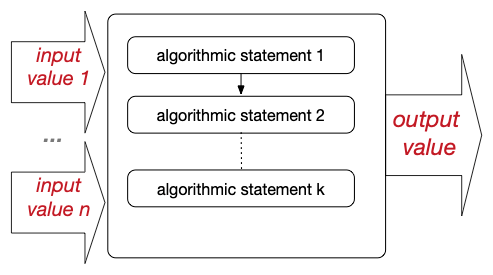
A possible definition
Values, variables and constants
Values in an algorithm
Values
34, 1.09, “IMT Atlantique” or false are values that can be integrated into calculus, as for instance 34 * 1.09 to get the conversion into euros of 34 dollars using a rate of 1.09.
Variables
-
Variables are names that refer to values, while constants are fixed.
-
Always favor variables over reuses of the same value.
-
Values have an associated type, which defines possible operations on them.
-
Programming languages define several elementary types (booleans, integers, real numbers, strings, etc.) and allow us to create your own composite types.
-
Data structures allow to group simple types into collections.
Values, variables and constants
Types of values
Variables
The type of a variable determines:
- which operations can be applied on it,
- the space used in memory to store its associated value,
- if its value may evolve.
The location where a variable is defined determine its visibility:
- as a global or local variable.
Algorithmic statements
Basic toolbox
The toolbox to write algorithms is very basic.
- defining variables / assigning values
- conditions
- loops
- defining / calling functions (focus of next session)
Algorithmic statements
Declaring variables and assigning values
Managing variables
- declare variables
- assign (calculated) values to variables
a : int = 34 * nbAlgorithmic statements
Control statements
Conditions
Conditional statements (if) are used to split the sequential execution of the algorithm based on a Boolean condition.
if est - reel < epsilon:
    print("Estimation found ", est)
else:
    print("Continuation")
Algorithmic statements
Control statements
Loops
Loops make it possible to define cycles in the execution flow of an algorithm.
# Initialize a few variables
v : List[int] = [1, 5, -5, 15, 0]
maxv : int = v[O] if len(v) > 0 else None
i : int = 0

# A loop that will iterate n times
for i in range(len(v)):
    if v[i] > max:
        max = v[i]
An invariant is used to prove by induction that a loop effectively reaches an expected state from an initial state.
maxv == max v[0:i]Recap of the session
What’s next?
Practical activity (~1h15)
Solving problems with algorithms
- Combining algorithmic statements
- Focus on loops
After the session
- Complete the practical activity
- Assess your understanding of the basic notions
- Check next session’s “Before the class” section